
Ag Leaders Convene at the NC Chamber’s Ag Allies Conference
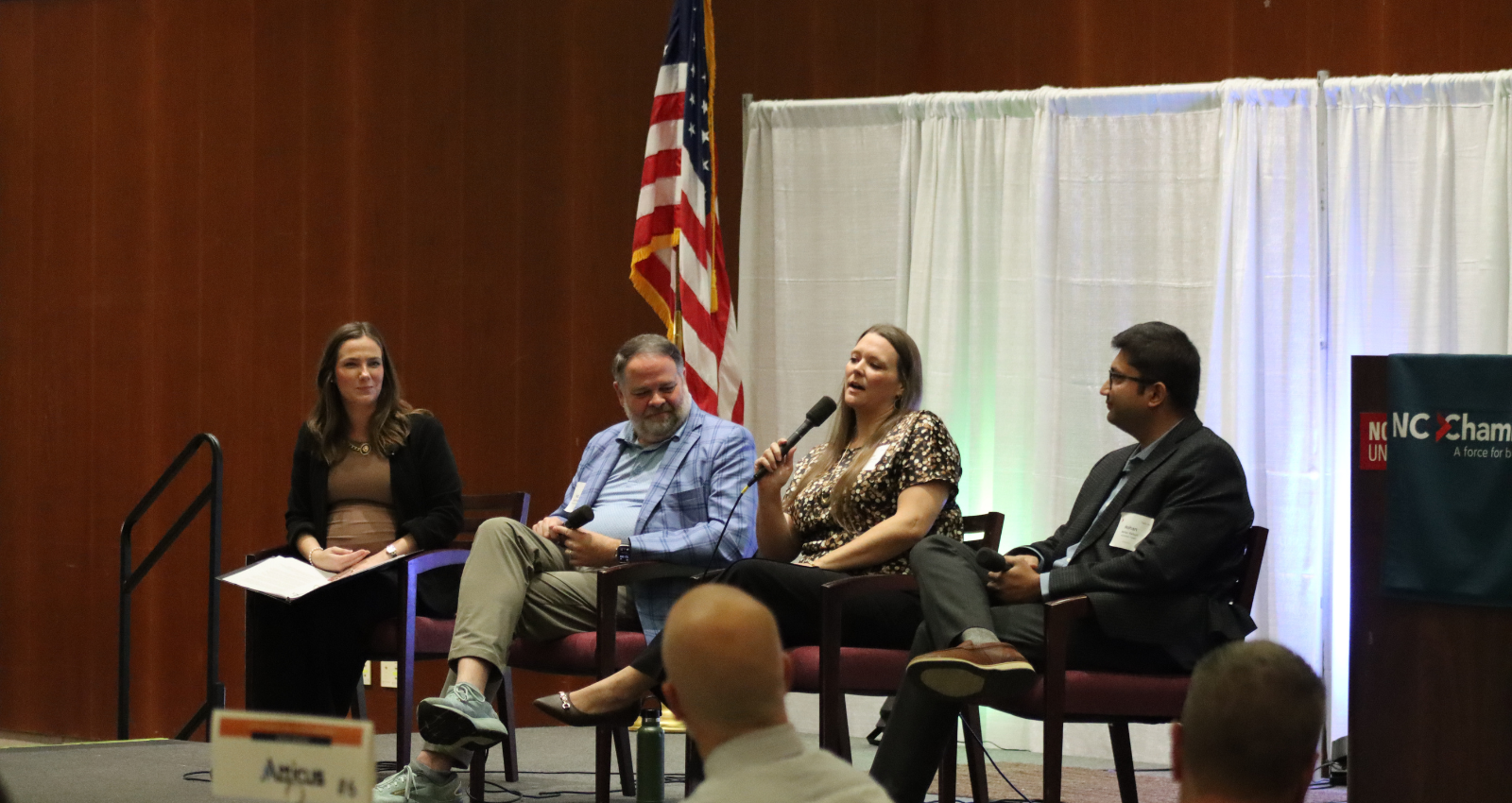
The NC Chamber’s 2026 Ag Allies Conference brought together national and state agriculture leaders to explore the issues shaping the future of North Carolina’s largest industry. The following Chamber Update breaks down the biggest takeaways from the day, including the need for long-term solutions to strengthen the farm economy, expand market access, and keep more agricultural value in North Carolina.
The Big Takeaways
- The farm economy is tough, and after-the-fact ad hoc payments haven’t fixed the underlying economics. Cattle operations are strong, but many row-crop farms are still losing money as input costs outpace prices. Roughly $150 billion in ad hoc aid over nine years has kept those farms afloat, and speakers agreed it was necessary. But across the day, the message was the same: after-the-fact payments are no substitute for a farm bill and a long-term strategy that farmers can plan around.
- Trade touches every corner of NC ag. With the U.S. signing 10 new agreements since 2025, the focus now is turning market access into real sales, which Ambassador Callahan said happens commodity by commodity as barriers come down. Trade came up in nearly every session, from beef’s untapped export potential to the case for competing on value-added products rather than bulk commodities.
- Everyone is keeping score, just not on the same scoreboard. Speakers measured success in trade deficits, farm balance sheets, jobs created and food security. Each matter, but they don’t always line up, and solving for one can mean losing on another. Brett Sciotto argued agriculture would be stronger if more of the value chain agreed on even a few shared goals and others called for more collaboration across the value chain.
U.S. Ag Trade Outlook
Ambassador Julie Callahan, Chief Agricultural Negotiator, Office of the U.S. Trade Representative, with Gregg Doud, President & CEO, National Milk Producers Federation
About the speakers: Callahan leads U.S. agricultural trade negotiations, a portfolio of roughly $180 billion in exports handled by an office of about nine people. Doud held the same job in the first Trump administration.
What we heard: Callahan said tariffs brought dozens of countries to the table at once, producing 10 new agreements since 2025 and putting the ag trade deficit on pace to be cut roughly in half this year. The deals target specific barriers, like beef plant listings and import licenses, and many give U.S. ag duty-free access. With China, a new “Board of Trade” covers $30 billion in U.S. exports, about half of its agriculture, on top of a 25 million metric ton soybean commitment. Canada, especially dairy, remains the toughest piece of the USMCA review.
Doud’s message was about follow-through. Trade wins fade without constant attention, and Callahan has flown more than 150,000 miles this year to keep them on track. In the Q&A, Callahan explained how the deficit connects to farmers. She tracks each trading partner as red (deficit) or green (surplus) against 2020, and a country turning red usually means a barrier went up or a commitment slipped. Reopening those markets, commodity by commodity, is how trade deals turn into real sales.
Why it matters for NC: North Carolina is a top exporter of tobacco, pork, poultry, and sweet potatoes. Callahan said USTR works commodity by commodity, so the specific barriers NC exporters face are exactly the kind of issues that shape trade negotiations.
Ag Economic Outlook
Bart Fischer, Ph.D., Co-Director, Agricultural and Food Policy Center (AFPC), Texas A&M University
About the speaker: Fischer spent more than eight years as chief economist of the House Agriculture Committee and helped write the 2014 and 2018 farm bills. AFPC’s analysis is what Congress relies on when it writes farm policy.
What we heard: Fifty of the 92 representative farms AFPC tracks, including North Carolina’s cotton and soybean farm, are in poor financial shape. Cattle ranches are almost all doing well, which is why national farm income numbers can look healthier than row-crop reality. Prices are off their lows, but diesel and fertilizer keep costs ahead of revenue.
Roughly $150 billion in ad hoc aid has gone to agriculture over nine years. “I don’t know a single farmer who likes this,” Fischer said. “I know tons of farmers who are grateful for it.” He argued that money belongs in the farm bill baseline, where farmers can plan around it. The One Big Beautiful Bill raised reference prices 10-20%, but input costs rose about 35% over the same period. Fischer believes a new farm bill can still get done, with House and Senate staff now working toward a final version.
Why it matters for NC: The NC farm in AFPC’s study, a diversified cotton and soybean operation modeled with local growers and Extension, is one of the 50 in poor shape. Two changes in the One Big Beautiful Bill matter for NC growers: farms that have been planting more than their historical base can add new base acres (growers will get about 97% of what they filed for), and family LLCs and other pass-through entities are no longer payment-limited at the entity level. Growers also have a deadline now: 2026 ARC/PLC enrollment closes December 11, 2027, enrollment is open, and AFPC offers a free decision tool.
Food Manufacturing in NC: A Symmetrical Opportunity for Ag?
Matt McCollum, President & CEO, Garner Foods (Texas Pete); Jamie Crumley, Founder & CEO, Harpley’s Meat Packing; Mohan Valluri, EVP, Alamance Foods. Moderated by Sarah Grace Lee, NC Chamber Foundation.
About the panel: Three very different NC food businesses. Garner Foods is a 97-year-old legacy brand whose signature product, Texas Pete hot sauce, has been made in Winston-Salem for generations. Alamance Foods is a large-scale and private-label manufacturer that makes products like whipped toppings, cold foam for drinks, and fun pops. Harpley’s Meat Packing grew from two people to about 170 in five years and is now the largest woman-owned beef processor in the U.S.
What we heard: The panel’s clearest message was that a lot of NC farm value leaves the state. Crumley processes more cattle each year than North Carolina raises, yet most NC cattle are shipped to the Midwest to be fed out, and much of her product goes out of state for further processing before coming back to NC grocery stores. Garner Foods buys tomatoes from California and peppers from New Mexico because NC lacks aseptic tomato processing and the climate for its peppers. Alamance Foods found gaps in NC dairy supply and processing as it expanded into yogurt and is investing to fill them.
On consumers, Valluri put it simply: “Consumer attention does not equal demand.” Crumley added that shoppers say they want local, but price and convenience drive what they buy.
Why it matters for NC: Each gap is an opportunity to grow, process and add value in-state. The panel’s prescription: build supply chains backward from demand, give farmers predictable demand, and judge economic development by value-chain impact, not just job counts.
American Food Power: The Road Ahead
Brett Sciotto, Founder, Center for American Food Power; CEO, Idealyst Innovation
About the speaker: Sciotto is a West Point graduate and former Army intelligence officer who has spent about 25 years studying the agrifood industry. He founded the Center for American Food Power this year to build a national agrifood strategy.
What we heard: Sciotto argued that food security is national security, and that U.S. agriculture faces a structural shift, not a cyclical downturn. The system built after World War II was designed to maximize bulk calories. Now, he said, the U.S. is no longer the world’s low-cost supplier and can’t beat Brazil on cost, but it can win on protein, nutrition, and value-added products. He pointed to three forces reshaping demand: rising global affluence, geopolitics, and dependence on rival nations for inputs like fertilizer, and Americans’ growing focus on health.
Sciotto supported the aid that has kept farmers in business but questioned the lack of direction behind it: “A bridge implies that you’re going somewhere.” He expects consolidation to continue either way, projecting that about 75% of U.S. farm output will come from roughly 60,000 farms within a decade. That, he argued, makes it more important to decide what the system is aiming for. Today’s system rewards growing more, and each part of the value chain optimizes its own piece with no one responsible for the whole. His answer: “fix the scoreboard” so success is measured by more than volume alone.
Why it matters for NC: Sciotto named North Carolina’s diversity, the third most diverse ag economy in the country, as the kind of strength that can lead a shift toward specialty crops, protein and value-added products. His call for a shared plan is the same work NC Ag Leads is doing at the state level: bringing farmers, agribusiness and partners together to figure out, collectively, what North Carolina agriculture should be aiming for and how to get there.
The American Meat Industry in Transition
Julie Anna Potts, President & CEO, Meat Institute, in conversation with Ray Starling, General Counsel, NC Chamber
About the speaker: The Meat Institute represents more than 95% of U.S. red meat by volume and 50-70% of poultry, from the largest packers to small processors like Harpley’s. Before leading it, Potts was a top executive at the American Farm Bureau Federation and chief counsel to the Senate Agriculture Committee.
What we heard: Meat demand is strong, and Potts sees it as a lasting shift. Every category was up in the Meat Institute’s latest Power of Meat survey, led by younger consumers and interest in protein. Beef supply is the constraint: the U.S. cattle herd is the smallest since 1951, and rebuilding it takes at least two years. Potts argued high beef prices reflect that tight supply rather than packer concentration and said sudden policy shifts can disrupt the price signals ranchers need to rebuild.
Labor is the industry’s biggest challenge. Beef processing still depends on skilled workers that automation can’t replace, and she expects a renewed push for ag and food worker visa reform after the elections. She also described Washington as more divided than at any point in her career: farm groups and food companies meet in separate rooms, and she is one of only two CEOs who sits in both.
Why it matters for NC: Pork and poultry are NC’s biggest meat sectors, and they share the same labor and policy pressures. North Carolina is also investing in local processing, and USDA just announced $57 million in grants to help independent meat and poultry processors expand. Potts said grants like these can jump-start a business, as one did for Asheboro’s Harpley’s Meat Packing, featured on the morning panel. Her caution: the money works best for plants with sound business fundamentals, not as a way to prop up ones that lack them.