
The Infrastructure, Businesses, and Workforce Behind North Carolina’s Sports Economy
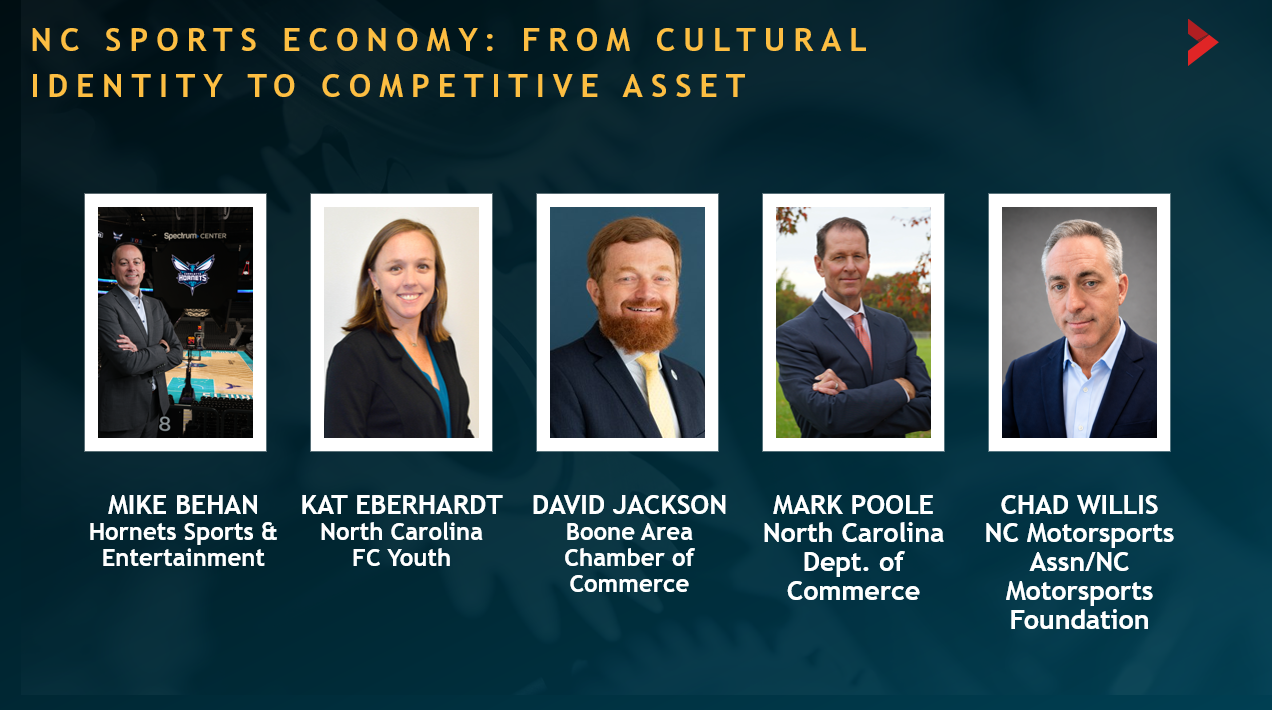
The NC Chamber Foundation’s Infrastructure and Supply Chain Council recently hosted a panel discussion to explore how sports facilities, specialized workers, supply chains, and business partnerships contribute to the state’s economic competitiveness. The webinar followed the Foundation’s September publication of North Carolina’s Sports Economy: From Cultural Identity to Competitiveness Asset, which examined the economic relationships among sports, infrastructure, tourism, manufacturing, workforce, and quality of place.
The panel discussion brought together a range of sports and economic development professionals, including Mike Behan of Hornets Sports & Entertainment, Kat Eberhardt of North Carolina FC Youth, David Jackson of the Boone Area Chamber of Commerce, Mark Poole of the North Carolina Department of Commerce, and Chad Willis of the North Carolina Motorsports Association and Foundation. While representing very different parts of the state’s sports economy, the panelists described common dynamics around facility investment, workforce development, business relationships, and the infrastructure needed to support operations and continued growth.
Putting Sports Infrastructure to Work Year-Round
Throughout the discussion, one of the strongest themes was asset utilization and, in this context, the importance of making existing sports facilities productive throughout the year, beyond game day. The Hornets’ Behan described how the Spectrum Center operates as a year-round destination for more than basketball and how the arena’s recent $245 million renovation, undertaken in partnership with the City of Charlotte, was designed not only to improve the fan experience, but also to make the facility more competitive when attracting major sporting, entertainment, and community events. Behan also emphasized that investments in the arena are supported by transportation, public safety, and the surrounding Uptown Charlotte business community. “Being able to get people to move around the city more easily is something that’s important to entertainment,” Behan explained. “If it’s going to be a headache, it’s going to be a challenge to get people around. People just won’t come.”
NCFC Youth’s Eberhardt shared similar challenges across a much different network of approximately 180 fields for practices, games, and tournaments used throughout a season. “Not all of those are game-ready fields or tournament-ready fields,” Eberhardt explained. “For practices, we’re trying to be as convenient as we can for families, taking up every school, municipality, church field, and open field. We know green space is a commodity.”
Lighting, turf, maintenance, parking, traffic management, and scheduling all affect whether fields can accommodate regular participation, league play, or major tournaments. NCFC Youth even maintains fields that belong to community partners and works with other sports organizations, schools, and colleges to host activities ranging from lacrosse, flag football, ultimate frisbee, and more.
In motorsports, Willis described how Charlotte Motor Speedway hosts concerts, seasonal attractions, corporate gatherings, and more alongside racing. “Building the facilities is what creates the opportunity,” Willis said. “But as the general managers and owners of these facilities will tell you, it’s filling the calendar that creates economic impact. Not just for them, but for the communities around the venues.”
NC Commerce’s Mark Poole emphasized that the long-term economic value of sports infrastructure depends on effective operations and investments suited to the communities they serve. “You want to right-size the asset,” Poole explained. “Everybody here has talked about activation, so that’s the key when you’re talking about the venues.”
The Workforce Behind, and Beyond, the Sports Economy
While facilities and events often receive the most attention, the panel also explored the substantial workforce required to operate North Carolina’s sports economy.
For Eberhardt’s NCFC Youth, the organization is supported not only by full-time employees and seasonal staff, but also as many as 2,000 volunteer coaches, referees, athletic trainers, maintenance crews, and numerous community partners. “It’s the engine behind it. It’s a lot of the unseen work of lining the fields, moving the goals every morning, making sure that every field is ready to play, that the surface is quality,” said Eberhardt. She also noted that youth officiating and coaching can be early pathways into employment, responsibility, and leadership.
Motorsports offers yet another dimension of North Carolina’s sports workforce, connecting competition to technical industries in advanced manufacturing, engineering, and operations. “We’re an economic development asset and a great example of a generations-long developed industry in this state,” emphasized Willis. “Sports is the front porch, but the economic engine behind it, the advanced manufacturing and technology, is really what we are at heart.” From motorsports, the state’s concentration of race teams, manufacturers, technology companies, and specialized suppliers has developed increasingly valuable capabilities in aerospace, defense, advanced mobility, and other sectors. “In racing, you’re constantly innovating under pressure,” Willis explained. “Competition is a week-to-week thing across all disciplines. Being able to innovate and manufacture and test under that pressure is something that this industry is really good at.”
Boone Chamber of Commerce President David Jackson highlighted the connections between collegiate athletics and professional motorsports. “One of the most decorated players in App State’s history, Richie Williams, has been a jackman for more than a decade in the NASCAR circuit after football,” Jackson explained. “Motorsports teams come to Boone regularly to find athletes that they can bring into some of those programs. These are people that are used to the big arena environment and working under pressure. They can stay involved in professional sports, maybe just not the way that they thought they would as their college careers come to a close.”
Business Opportunities Beyond Sponsorship
For the broader business community, sports offer commercial connections. “We want to be a platform to drive commerce, to drive relationships within our ecosystem,” Behan said. “There’s a component of that that’s to create awareness around their business, and probably a more valuable piece for many is to get to know each other and build that sense of community amongst those sponsors and premium hospitality ticket holders.” The Hornets are developing opportunities for corporate partners to connect year-round beyond games and traditional sponsorships.
When asked where North Carolina companies that don’t traditionally consider themselves to be a part of the sports industry might find opportunities to get involved, Willis encouraged businesses to start by considering how their existing capabilities might serve sports organizations and could lead to opportunities for supplying equipment, solving operational challenges, developing technology, and serving new customers. Eberhardt similarly pointed to opportunities for employers to support youth sports through local partnerships, funding, and in-kind contributions, benefiting the communities where employees and their families live.
From Sporting Events to Lasting Economic Value
Beyond facilities and business relationships, the panel explored how sporting events have an impact beyond a single weekend or event. Poole discussed NC Department of Commerce’s growing experience supporting sports, including the Women’s Tennis Association’s decision to establish its global headquarters in Charlotte while also bringing the WTA Finals to Spectrum Center in 2027, 2028, and 2029. The announcement, supported through North Carolina’s Major Events, Games, and Attractions (MEGA) Fund and other local partnerships, also includes plans for a future WTA 500 tournament beyond 2029.
“Through these incentives, we were able to secure the WTA Finals, 2027 through 2029. But the relocation of their headquarters to Charlotte is a huge win for the community,” Poole explained. “WTA is all-in not only for the Charlotte area but across the state, really getting into collegiate tennis and youth tennis.”
At the community level, Jackson described how Appalachian State athletics, as well as the High Country’s regional skiing, outdoor recreation, and endurance event industry, introduces visitors to Boone. “It’s the repeat business that large-ticket events can bring, whether that’s wintertime skiing or fall Saturdays at the Rock,” Jackson explained. “You don’t come to a football game to go buy pottery on King Street, but you may just come back another weekend when there’s not a game and have that experience.”
For a professional sports organization like the Hornets, the scope of community includes both Carolinas, north and south. “We made it a commitment to get out and go meet people where they were, and so we hosted 40 events across North and South Carolina,” Behan explained. “We continued that over the course of the year with our community impact team and have made significant contributions.”
Building on North Carolina’s Competitive Strengths
As North Carolina’s sports economy continues to evolve, additional research can help identify opportunities for business development, workforce growth, investment, and innovation. New research on the state’s motorsports sector slated for completion by April 2027 will examine the industry’s economic contributions, manufacturing and research capabilities, workforce, supplier networks, and opportunities for growth across multiple racing disciplines. Willis reinforced the importance of understanding these connections during the panel, “Our motorsports industry isn’t supporting just racing. We’re creating a highly skilled workforce, a specialized supplier network, and we’re a base of new technical capabilities here in North Carolina that can attract new businesses.”
Strong Connections to the NC Chamber Foundation’s Research
The Oct. 20 discussion highlighted just how North Carolina’s diverse sports organizations share common needs for capable workers, reliable infrastructure, strong partnerships, and continued investment to remain competitive, and that opportunities for growth in sports go beyond the expected. Recognizing the people, businesses, and infrastructure that sustain North Carolina’s sports assets is an important part of understanding their value and identifying yet more ways to bolster our state’s robust competitive advantage.
Read the NC Chamber Foundation’s full report, North Carolina’s Sports Economy: From Cultural Identity to Competitiveness Asset.