
Foundation Forecast: North Carolina’s Labor Force Challenge Is a Competitiveness Issue

North Carolina’s growth story is real. But population growth, project announcements, and strong education assets do not automatically produce the labor force employers need.
The latest edition of Foundation Forecast, developed with input from Dan Gerlach, economic advisor to the NC Chamber, and Dana Magliola, senior director of infrastructure competitiveness at the NC Chamber Foundation, examines recent labor force trends across North Carolina, including what they mean for the state’s long-term competitiveness and why sustaining momentum will require intentional action to strengthen workforce participation. The findings reinforce priorities central to the NC Chamber Foundation’s work through NC Leads to reduce barriers to employment and connect more North Carolinians to opportunity.
Meredith Archie
President
NC Chamber Foundation
Foundation Forecast: North Carolina’s Labor Force Challenge Is a Competitiveness Issue
Employers hire from the labor force, not from population totals or job announcement numbers. The labor force includes people who are working or actively looking for work. That distinction matters. For business leaders, labor force growth is one of the clearest measures of whether a region can support hiring, expansion, production, and long-term competitiveness.
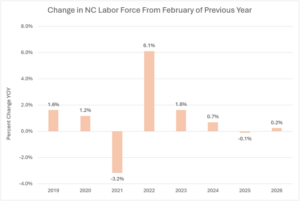
Source: LAUS, NC Commerce (LEAD); US Bureau of Labor Statistics
The latest data show a clear warning sign. After rebounding strongly from the COVID-19 pandemic, North Carolina’s labor force growth has slowed sharply. From 2018 to 2024, the state’s labor force grew by 8.0 percent. From 2024 to 2026, it grew by only 0.1 percent. The recent slowdown is a warning that the state cannot assume workforce growth will automatically keep pace with economic growth.
The Challenge Is Not Evenly Distributed Across the State
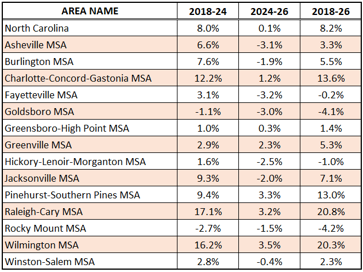
Source: LAUS, NC Commerce (LEAD); US Bureau of Labor Statistics
North Carolina’s labor force trends vary significantly by region. Several metropolitan areas continue to show strong long-term growth. At the same time, many communities are moving in the opposite direction. Since 2024, more than half of North Carolina’s metropolitan areas have experienced labor force declines, including Asheville, Burlington, Fayetteville, Goldsboro, Hickory-Lenoir-Morganton, Jacksonville, Rocky Mount, and Winston-Salem. These regions are home to important economic assets, including military installations, manufacturing clusters, agricultural production, tourism economies, and logistics networks. If labor force participation continues to weaken, the challenge becomes a regional competitiveness issue.
Workforce Development Board data reinforces this pattern and provides a broader view of labor force conditions across the entire state, including communities not fully captured by metropolitan-area analysis. Cape Fear, Capital Area, Centralina, Charlotte Works, Durham, and Kerr-Tar all posted strong growth from 2018 to 2026. But Lumber River, Turning Point, Western Piedmont, and High Country ended the period below or near their 2018 labor force levels, while Mountain Area saw a sharp decline from 2024 to 2026.
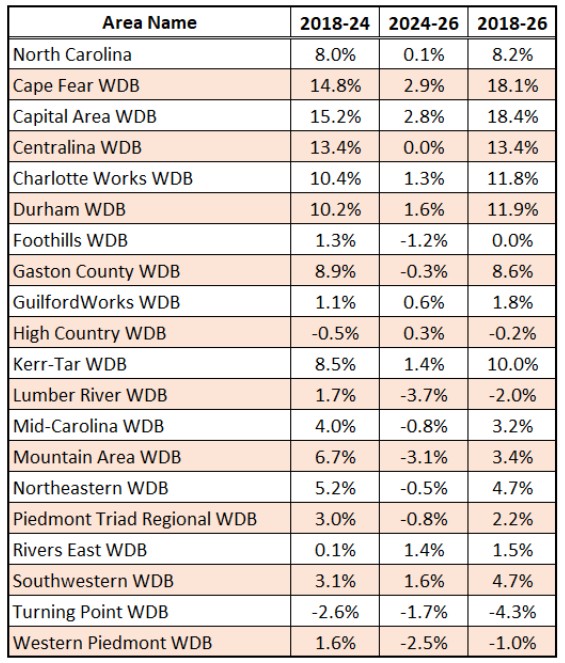
Source: LAUS, NC Commerce (LEAD); US Bureau of Labor Statistics
These differences underscore an important reality. North Carolina’s workforce strategy needs to be regional, recognizing that not every part of the state will grow at the same pace.
Fast-growing communities need infrastructure, housing, childcare, and mobility systems that can keep up. Slower-growth regions may need a different focus, including reducing barriers for existing residents, reconnecting workers to nearby jobs, and aligning industry recruitment strategies with the labor force available.
Removing Barriers to Workforce Participation
For years, North Carolina has benefited from people moving here from other states and countries. Continued in-migration will remain important, but the state cannot rely on population growth alone. North Carolina also needs to help more current residents enter, remain in, or return to the workforce.
Affordability pressures are now part of the workforce equation. The cost of housing, childcare, food and gas, transportation, and basic household stability all affect whether people can accept a job, keep a job, or move closer to better opportunities. These pressures show up differently across regions, but they matter in every labor market.
Childcare is one of the clearest examples. When parents cannot find or afford reliable childcare, many reduce work hours, delay returning to work, or leave the workforce altogether. For employers, childcare access shows up as a workforce constraint that reduces labor force participation and shrinks the available talent pool. Lack of accessible childcare costs North Carolina an estimated $5.65 billion in lost economic activity each year. The NC Chamber Foundation identified practical, employer-informed solutions to improve access to childcare so more parents can work.
Transportation is a labor force issue as much as an infrastructure issue. When workers cannot reliably reach jobs, employers draw from a smaller labor pool and growth becomes harder to sustain. That risk is growing in North Carolina, where the state’s 2026 infrastructure report card gave roads a C- and found that nearly two-thirds of state roads are only in fair condition, with more than 80,000 lane miles under increasing strain from age, traffic, and inflation.
Western North Carolina showed what that looks like in practice after Hurricane Helene. Damaged road access and prolonged water service disruptions in Asheville interrupted business activity, commuting, and basic operations across the region. Those disruptions hit at the same time labor force participation was already weakening in parts of the west, including declines in the Mountain Area and Western Piedmont from 2024 to 2026, making infrastructure reliability part of the state’s workforce competitiveness challenge, not a separate issue.
Housing, childcare, transportation, and affordability are horizontal workforce issues that affect every industry, from small businesses and local service providers to manufacturers, healthcare systems, and major corporate operations.
At the same time, North Carolina also needs vertical workforce strategies tailored to the sectors it is actively trying to grow. State economic development efforts, EDPNC recruitment, workforce investments, and regional strategies tied to advanced manufacturing, life sciences, healthcare, education, logistics, defense, energy, and other target industries all depend on whether those sectors can find and retain the workers they need.
Competitiveness Depends on Workforce Participation
North Carolina does not need every region to grow the same way. But every region needs a realistic workforce strategy that connects people to opportunity and employers to talent. In some places, that means keeping pace with rapid population and job growth. In others, it means reducing barriers that keep current residents from working, improving access to job centers, strengthening job quality, and rebuilding capacity after disruption.
The state’s continued economic leadership will depend not just on how many people move here, but on how well North Carolina connects its current and future workforce to the employers, infrastructure, and regional economies that need them.
1 All labor force data is from the US Bureau of Labor Statistics, Local Area Unemployment Statistics, for various years found at: https://d4.nccommerce.com/LausSelection.aspx
2 US Chamber of Commerce Foundation, Untapped Potential in NC, https://ncchamber.com/wp-content/uploads/Untapped_NORTHCAROLINA_053124_DIGITAL.pdf
3 American Society of Civil Engineers, 2026 North Carolina Infrastructure Facts, https://infrastructurereportcard.org/wp-content/uploads/2026/03/north-carolina-2026-fact-sheet-1.pdf