
Foundation Forecast: Top Two Again, Plus Signals for Tomorrow’s Competition

North Carolina’s six-year run as one of CNBC’s top states for business is an achievement worth celebrating. It is also an opportunity to better understand what is driving the state’s success and what will be required to stay competitive in the years ahead.
In this edition of Foundation Forecast, Dana Magliola, senior director of infrastructure competitiveness at the NC Chamber Foundation, examines the trends behind this year’s rankings and the priorities that will determine future competitiveness. The analysis reinforces that the NC Chamber Foundation remains focused on the issues that matter most to employers and North Carolina’s continued growth.
Meredith Archie
President
Foundation Forecast: Top Two Again, Plus Signals for Tomorrow’s Competition
CNBC recently released its 2026 America’s Top States for Business rankings with North Carolina once again finishing among the most competitive states in the country. This year, North Carolina ranked #2 overall after holding the #1 spot last year. North Carolina has finished either first or second for the past six years. That is worth celebrating…and studying.
North Carolina’s continued strength is showing up where the competition is hardest. CNBC ranked North Carolina #1 for economy and #3 for workforce in this year’s ranking. Those are two of the clearest signals that companies continue to see North Carolina as a place where they can grow, invest, and compete. The economy ranking speaks to the state’s momentum as North Carolina continues to attract major projects, support a diverse industrial base, and benefit from population and employment growth. The workforce ranking shows that talent remains one of the state’s strongest competitive advantages, supported by higher education, community colleges, in-migration, talent management innovations, and a business community that continues to invest in people and training.
Those strengths helped keep North Carolina near the very top. CNBC’s 2026 methodology placed a combined 760 points on economy and workforce, just over 30 percent of the total score. A state that performs well in those two categories has a strong foundation for long-term competitiveness. These rankings also show where the next phase of competition is headed. That signal is visible in the category weights themselves, with infrastructure growing from 15 percent of CNBC’s total score in 2021 to 17.6 percent in the latest contest where it became the largest single category on the scorecard.
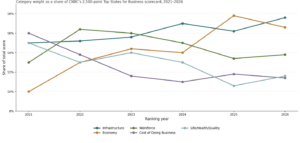
The CNBC infrastructure category now reaches well beyond roads and bridges. It includes freight movement, air access, commute times, broadband, power reliability, power cost, power generation capacity, water availability, water and wastewater utility conditions, site readiness, vacant industrial space, large-scale computing power, access to markets, permitting speed, and resilience. Now, a catalog of metrics. That expanded definition reflects what businesses are asking for right now. Companies choosing sites for advanced manufacturing, life sciences, logistics, aerospace, defense, and food production need more than a good tax climate. They need sites, workers, roads, rail, power, water, data, a supply chain, and permitting systems that move at the speed of investment.
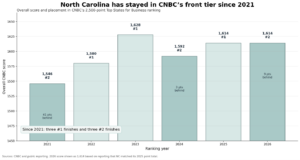
Ohio took the top spot this year, finishing just nine points ahead of North Carolina. The network pointed to Ohio’s strength in infrastructure and cost of doing business, including a #1 finish in both categories. Nine points is a narrow margin, but it is also useful data that the top states are separated by very little. Over the last three CNBC rankings, North Carolina has either finished first or lost the top spot by the smallest of margins, falling short in 2024 and 2026 by a combined 12 points.
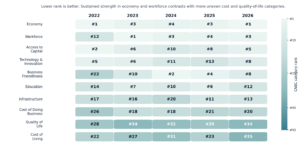
The state’s #2 overall ranking confirms that our economic development fundamentals remain strong. The #1 economy ranking confirms that the growth engine is working. The #3 workforce ranking confirms that talent and human capital remain a leading advantage. The next competitiveness test is whether North Carolina can build enough capacity to support its growth. For the state, that will demand modernized infrastructure, reliable and affordable energy, long-term water and wastewater planning and freight networks that connect manufacturers, farms, markets, suppliers, ports, airports, rail lines, and customers. It means project-ready industrial sites. It will take permitting systems that protect communities while giving businesses the speed and predictability they need. It also means housing, childcare, and quality-of-life assets that help workers live near opportunity.
Last year’s scorecard gave North Carolina a clear preview of this challenge. In 2025, North Carolina ranked #3 for economy, #4 for workforce, #4 for business friendliness, #6 for education, and #8 for access to capital. Those were the strengths that helped return the state to #1. At the same time, North Carolina ranked #11 for infrastructure, #21 for cost of doing business, #23 for cost of living, and #29 for quality of life. Some measures also cut both ways. North Carolina’s right-to-work status remains a longstanding competitive advantage because it protects the right to work without an employee being required to join a union or pay union dues as a condition of employment. CNBC’s quality-of-life methodology may weigh related labor policy factors differently.
Beyond the rankings themselves, North Carolina’s challenge is showing up in categories tied directly to the pressures of growth. A pro-growth climate continues to help companies choose North Carolina, and the private-sector investment and job creation that follow are a major reason our state remains near the top. But the competition is getting sharper. States are racing to secure the assets that will define the next generation of growth, from talent and energy capacity to data infrastructure, advanced manufacturing, logistics, and defense production. The states best positioned to win will be those that can match business investment with the speed and capacity needed to sustain it.
North Carolina remains in that front tier. Six straight years in the top two is a remarkable achievement. A #1 economy ranking and #3 workforce ranking show that the Old North State’s core competitive strengths are still among the best in the nation. The next step is clear. Congratulate Ohio on this year’s top finish, then get back to work.