
Cutting Through the Noise on Data Centers

Noise has become one of the most common arguments raised against data center projects in communities across the country, appearing in local moratoriums, zoning disputes, and a growing wave of litigation. But a new analysis from the Taxpayers Protection Alliance asks a simple question, what does the evidence actually show?
The answer is worth understanding before North Carolina’s policy conversation gets shaped by claims that don’t hold up.
What the Research Shows
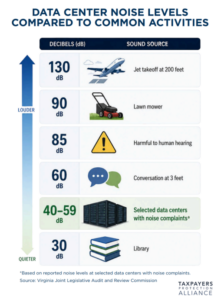 The most comprehensive independent review of data center noise to date comes from Virginia’s Joint Legislative Audit and Review Commission (JLARC), which conducted an extensive study in 2024. JLARC examined noise levels at data center facilities that had generated actual resident complaints and found that even those facilities typically produced noise in the range of 40 to 59 decibels.
For context, a normal conversation at three feet is about 60 decibels. A library registers around 30. The Occupational Safety and Health Administration sets 85 decibels as the threshold at which prolonged exposure becomes harmful to human hearing. Even data centers that generated complaints landed well below a normal conversation and nearly 30 decibels below the level OSHA considers a public health concern.
The Taxpayers Protection Alliance brief, released in July 2026, synthesizes JLARC’s findings alongside other sound impact assessments and engineering analyses. Its conclusion is consistent across sources. At the property line, modern data centers typically register between 45 and 55 decibels, which is comparable to a household refrigerator or a quiet suburban street.
How Modern Facilities Are Built
Part of why the noise narrative is disconnected from reality is that critics often rely on outdated assumptions about how data centers are constructed.
Today’s facilities are engineered with noise control as a design priority. Variable-speed industrial fans adjust to actual cooling demands rather than running at full capacity around the clock. Acoustic baffles, sound-dampening walls, and ventilation silencers treat noise at the source. Liquid cooling systems, which are increasingly standard in AI-intensive facilities, significantly reduce reliance on the high-decibel air-chilling units that older facilities depended on.
A recent sound impact assessment for Project Tango, a proposed 600-megawatt hyperscale AI campus in Florida, illustrates what modern engineering can achieve. Despite its scale, the project was designed to a steady-state 45 decibels at the nearest residential property line — below both the local municipal cap and the existing ambient noise level of the surrounding neighborhood. That result came from deliberate design choices, including low-noise equipment, specialized sound barriers around transformers, and primary mechanical infrastructure enclosed within sound-attenuating buildings.
Facilities are also subject to local noise ordinances regardless of whether a specific project generates complaints. Most jurisdictions set daytime limits of 55 to 65 decibels at the property line and nighttime limits of 45 to 55 decibels — rules that apply to data centers and that independent auditors routinely monitor.
The Stakes for North Carolina
More than 100 communities across the country have enacted moratoriums or zoning restrictions on data centers, and noise concerns have been a recurring justification. North Carolina communities are having similar conversations.
Those conversations deserve accurate, data-based information. When noise concerns are based on anecdote or extrapolation from outlier situations rather than the engineering standards that govern modern facilities, policy responses can impose real costs on communities that stand to benefit significantly from this investment.
The evidence supports the position that noise, while a legitimate local consideration worth addressing through siting requirements and sound assessments, is not the crisis that opponents often claim. Communities that demand good engineering, and hold developers to it, are in a strong position. Communities that use noise as a blanket justification for restriction are leaving economic opportunity on the table based on claims the data does not support.