
Business Playbook Returns with Wide-Ranging Conversation on State’s Future
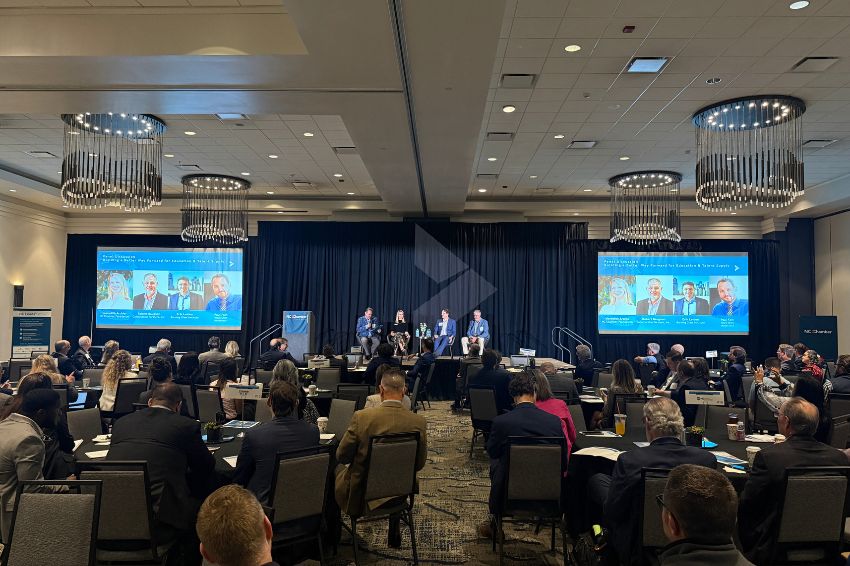
From workforce and infrastructure to healthcare and national security, the second annual event tackled the full breadth of North Carolina’s economic opportunity — and the work required to sustain it.
Two days after the midterm elections reshaped North Carolina’s political landscape, more than two hundred business and civic leaders gathered for the NC Chamber’s second annual Business Playbook event to look ahead. Across six sessions at the Embassy Suites in Cary, the conversation covered the full spectrum of the state’s competitive position and the work required to protect it.
A Long View on What Made North Carolina Successful
Biosciences executive and NC Children’s Board Member Jack Bailey opened the day with a sweeping assessment of the state’s strengths, including a diversified economy, the nation’s most populous military installation, and a geographic advantage that allows commerce and people to move efficiently. But his most urgent remarks focused on pediatric healthcare.
North Carolina is home to 2.3 million children and that is only expected to grow as we remain a top state for population growth and in-migration. Yet we are the largest state without a freestanding children’s hospital and as many as twenty of our state’s 100 counties have no pediatrician. North Carolina leads the nation in airlifting children to other states for complex care. The proposed 500-bed NC Children’s facility, backed by $424.5 million from the General Assembly and $100 million from the Duke Endowment, would change that. It would also bring an economic boost with an estimated 8,500 workers affiliated with the campus and 9,500 supporting it.
Education & Talent: Aligning Skills with Opportunity
The education and talent panel, moderated by Paul Fain, co-founder of Work Shift and editor of The Job, surfaced a core tension. North Carolina is attracting more skilled workers than ever, while its labor force participation rate, the percentage of people aged 16 and up with a job or looking for one, sits at 57.8%.
Robert Baugnon of Construction Partners, whose 7,500-person workforce is two-thirds skilled trades, noted that an 18-year-old today receives dozens of solicitations to attend college and none from a trade school. Erik Leiden of Burning Glass added that there is often little alignment between the jobs with the most openings and the CTE programs schools are offering. Leiden did say that sentiment data is improving on trade schools, but it’s not translating into big moves on the entrance numbers nationally – yet.
Meredith Archie, president of the NC Chamber Foundation, pointed to the NC Health Talent Alliance, the Foundation’s partnership with the NC Center on the Workforce for Health, as a proof point for tailored solutions built around measurable outcomes. Shifting away from a focus on activity helps align investments, training capacity, and resources to achieve a specific workforce goal. The New Hanover Healthcare Career Partnership has been able to raise their nursing graduation rate from 53% to 85%. Careers Electric brings that model to our state’s electrical workforce, with the Foundation serving as an incubation partner backed by a U.S. Chamber of Commerce Foundation grant to align K-12 career pathways with employer demand.
Infrastructure: Building Ahead of the Need
The infrastructure panel delivered a lesson in what growth looks like from the ground up — and how hard it is to keep pace with it.
Oliver Brooks of Martin Marietta reminded attendees that North Carolina’s transportation wish list totals $144 billion against a funded STIP of $31 billion. The issue is compounded by the fact that federal highway dollars, still tied to a gas tax last raised in 1993, generate about $19 per driver per month, or what Brooks estimates as the same cost as a streaming subscription, for unlimited use of the entire road network.
Teresa Wilson of Enbridge pointed to Mecklenburg County as a case for investment though. Voters there approved a 1% sales tax specifically for transportation, which is projected to unlock $20 billion over 20 years. It is seen as a signal that when the case is made clearly, the public will invest in the infrastructure it needs.
The NC Chamber Foundation and NC Chamber have long provided data-based research on this funding gap and successfully advocated for funding modernization, including securing a share of state sales tax revenue for transportation in 2022. Continued modernization of infrastructure funding is expected to be a cornerstone of the coming legislative agenda.
Shannon Becker of Aqua NC added that large wastewater projects take five to eight years to build, meaning communities that wait for growth to arrive before investing are already behind. The NC Chamber Foundation’s Water Infrastructure Competitiveness Analysis makes a similar case for water, calling for coordinated planning among policymakers, utilities, and industry to stay ahead of growth.
The Election Context: Looking Beyond the Political Wave
Republican strategist Jim Blaine and Democratic strategist Kimberly Reynolds went Beyond the Ballot over lunch two days after Democrats took control of the state House for the first time since 2010.
Even as voters elected Democrats in historically Republican districts, they passed a constitutional amendment reducing the maximum income tax rate from 7% to 3.5%, a signal that rising costs are the mandate, not a partisan agenda.
“We have historically worked across party lines, so I think everything from our agenda is on the table.” — Gary Salamido, NC Chamber President & CEO
Gary Salamido shared the NC Chamber’s perspective with the Triangle Business Journal last week. The path forward requires building new relationships now and showing up as part of the solution to the affordability pressures voters made unmistakably clear. The election is over and the work of keeping North Carolina competitive continues.
Feed, Cure, Defend: North Carolina’s Strategic Role
The afternoon panel reframed North Carolina’s economy around a single question: what happens when the things America takes for granted stop arriving?
Jay Jandrain of Butterball made the food security case with COVID-19 as his evidence. The pandemic didn’t create a shortage, but it exposed a supply chain brittle enough to shake consumer confidence and cost jobs. His company has since lost 10% of its workforce to changes in temporary visa programs, a reminder that agricultural labor is as much a policy issue as a farming one. That is why the NC Chamber formed a national H-2A reform coalition, pushing for a more workable wage methodology for agricultural employers.
Richard Latchford of GSK put the healthcare stakes in stark terms sharing that 60% of American adults have a chronic preventable illness, 40% of which are treatable, and none of that improves if the supply chain delivering medicines fails.
With three active global conflicts, depleted U.S. stockpiles, and decades of consolidation that have left domestic production capacity far below what demand now requires, Brandon Keener of JGA Space & Defense sees tremendous defense opportunity for our state. North Carolina’s manufacturing workforce, he argued, is positioned to fill that gap, particularly in tier-three supplier contracts, where multi-year commitments make long-term investment viable. JGA is a member of First in Defense, the coalition the NC Chamber and the NC Critical Technologies Alliance launched to help North Carolina capture a larger share of federal defense investment.
The State’s Balance Sheet — and a Healthcare Reckoning
Treasurer Brad Briner closed the day with an honest accounting. The good news is that North Carolina holds AAA ratings from S&P and Moody’s, and the pension fund returned 13% in its first year under the Investment Modernization Act against a 6.5% target. The challenge is that Medicaid spending in the last enacted budget was $34.4 billion and Briner projects the state will spend $41.6 billion this year, with $1 billion more projected next year.
“Until we get healthcare costs under control, that is going to consume anything else we want to do.” — Treasurer Brad Briner
The Healthcare Affordability Commission Briner co-chairs and NC Chamber President and CEO Gary Salamido serves on, is pursuing certificate of need reform, scope of practice modernization, health information exchange participation, and price transparency. A tiered health plan network, in which Novant and UNC Health compete for preferred status by lowering costs, is already a proof of concept, with state employees on track to cut out-of-pocket costs for routine services nearly in half by 2027.
The NC Chamber’s next events are Women Lead NC on December 2 and the Economic Forecast Forum on January 20, both at the Raleigh Convention Center.