
2025 Education and Workforce Conference Centers on Skills
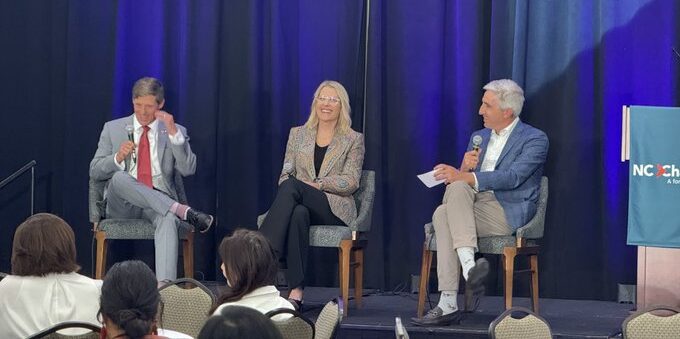
One of the only events in North Carolina that brings together leaders from both business and education to address growing and maintaining the workforce, the NC Chamber’s 2025 Education and Workforce Conference drew more than 260 attendees.
Presented by Ellucian, the event featured an engaged audience of North Carolina leaders discussing some of the following themes. Missed the event? Click here to receive an alert for next year’s program.
Talent: Competitiveness and Growth Imperative
According to Stuart Andreason, executive director of programs at Burning Glass Institute, skills are what determines the future readiness of a workforce. Technologies will continue to intersect existing job roles, shifting the skills needed to succeed in those roles.
Andreason says that 37% of the skills of an average job have changed over the last five years. Today, new power skills drive our labor market and, increasingly, digital skills are required for high mobility jobs. For a region to succeed in the war for talent, they must identify these power skills and invest in training and reskilling around those.
While much has been made about the role generative AI and the proliferation of AI will have on our job market, Andreason says that the trends remain the same, AI is just accelerating the pace of change. Despite a focus on potential disruption in roles from AI – meaning job loss – the adoption of similar innovation has not always ended in fewer jobs.
For example, Microsoft Excel was released in the 1980s and people thought analysts would become irrelevant. Instead, the opposite happened, it unlocked a huge amount of data demand and today most companies employ data specialists.
The strategy around AI should focus on the technology and our ability to adopt it. Our communities must identify the needed skills and get to work enabling programs that connect our local workforce to those skills.
When it comes to advising individuals, Andreason likens the career to a chess game, saying there are different moves available, but certain moves better set you up for success than others. He deems work-based learning the key to career success. While credentials can provide access, they do not always provide wage growth, and it is important for people to better understand what they will get from a specific credential.
Business to Business: How to Maintain and Grow Your Workforce
Skills and work-based learning were themes of a panel of business leaders, moderated by Senator Eddie Settle (R-36). Transfr Inc. State Workforce Manager Tyler Robinson reminds attendees, “you can’t be what you can’t see.”
Bringing hands-on VR training to students helps Transfr make career exploration and workforce development more engaging and effective. Virtual reality allows the team to put a headset on a student and introduce them to careers by showing them what it looks like. The tools can also teach individuals the tools and skills they need from assessing vital signs of a patient to using a chop saw. Transfr then works with local workforce boards and community colleges to connect the students with a career pathway to secure those jobs.
It comes down to helping people help themselves. Dean of Academic Programs at OIC of Rocky Mount, Greg Singleton shared that 1.3 million North Carolinians have a criminal background. “What if we got a quarter of those people into the workforce?” he asked.
Education reduces poverty as well as prison recidivism. Singleton encourages employers to look at barriers like transportation, child care, food nutrition, substance abuse, and mental health treatment. That is happening in community colleges already. The Building Bridges program at Craven Community College partners with the Food Bank of Central & Eastern North Carolina to fund all tuition costs for qualified students seeking to enroll in a CDL or forklift class. Students are provided a $200 weekly support scholarship while enrolled in one of the programs, in addition to other costs being covered by the scholarship, tailored for those who are unemployed, underemployed, or justice involved.
Scott Nunn, facilities engineer at Novo Nordisk, encourages all businesses to find a way to connect with the education partners in their community. He emphasizes that you have to be willing to invest your money, time, and knowledge. “The biggest thing you can give is time,” said Nunn. Novo Nordisk invests its time in engaging experiences that are more than job shadowing, including real-world applications with tasks in their internships, paired with a coach or mentor to guide interns through working in the real world.
Robinson explained, “Personal and professional relationships usually end because of unset expectations.” Business can do a better job of setting the expectations of a career through offering an opportunity to experience it.
Leaning In: Strategically Addressing Talent Pipeline Challenges from the Top Down
NC Chamber First Vice Chair Jim Hansen, regional president and southeast territory executive at PNC Bank, moderated a discussion with James Banner, NC Chamber board member and senior vice president of administration and safety at Pike Corporation, and Laura Ipsen, president and CEO of Ellucian.
The three leaders “have been there and are doing that” to strategically address talent pipeline challenges and they all agreed that talent and workforce is everyone’s issue, not just an HR responsibility.
“We all have to be thinking about how we put the talent on the field for our organization. It’s about what we do every day, our brand, how we show up, referrals from employees, our connection to communities, and giving back time. Touch points have to be digital and human,” said Hansen.
That work takes relationships. Banner described word of mouth, trade schools, and engaging in curriculum development at 13 community colleges as integral to Pike’s talent development. A top source though comes from the 20,000-transitioning military in our state, and their spouses. Ten percent of Pike’s annual hires come from that pipeline, largely through a relationship with North Carolina for Military Employment, or NC4ME.
Ipsen echoes the relationship theme, but with a focus on leveraging your relationship with technology. Ellucian can see what’s working and what is not, which helps offer strategic insights on where to scale. Right now, there is a surge in relearning through credentials and the stacking of those. Her team is working to make data and insights into the workforce needs more predictive to help enable where education is going. As the required skills for jobs change, it is more important than ever for business and education to be connected.
While many of the skills needed change rapidly, emotional intelligence continues to reign supreme. As Banner explained, “If we work on a power line, that worker still has to knock on the door and tell someone that you will turn off their power.” He went on to tout the importance of partnership with your local community or technical college. “They listen and they want you to hire their people, whether you are an employer of five or 50,000, they want to hear from you, do not think you are too small,” he said.
While engagement can feel daunting, Banner reminded attendees that Pike is spread between 75 offices of people who work out in a community, not at a desk. “Let your people engage on behalf of your business,” he recommends. Relationship building must be a shared responsibility.
Ipsen also offered valuable advice saying, “Workforce investment, reskilling and upskilling, is not a partisan issue. We are all in for it.” During this time where AI is providing so much opportunity, she encourages all to leverage the technology to learn what jobs are available and the skills it takes to get those jobs.
“Our community college system is a differentiator around the country,” said Hansen. “North Carolina will be the 7th most populous state in America by 2030, passing Georgia and Ohio. We will likely be 5th by 2040. There are great opportunities in North Carolina. That means more work for all of us to connect, invest in communities and our economies. The ask is: don’t sit back, make connection! We are all thinking about it, it matters.”